A guest forms an opinion about your hotel within minutes of walking in. Long before they judge the food, the service or the bed, they have already registered the lobby sofa, the reception desk, the colour of the walls and the way the light falls on the furniture. In hospitality, furniture is not a background detail. It is part of the product you sell.
That is why hotel furniture is changing so quickly. Guests travel more, compare more and share more. A room that looks unremarkable on a phone screen is a missed marketing opportunity, and a lobby that looks tired can cost a property its reviews. Hotel owners, developers and the interior designers who work with them are rethinking what furniture should do, how it should look and how long it should last.
This guide covers the hotel furniture trends shaping 2027, what they mean room by room, and how to turn a design idea into furniture that survives real commercial use. If you are an interior designer or project consultant planning a hotel, resort or boutique stay, there is a dedicated section on sourcing furniture in bulk further down.
Trend 1: Warm, Earthy Colour Palettes
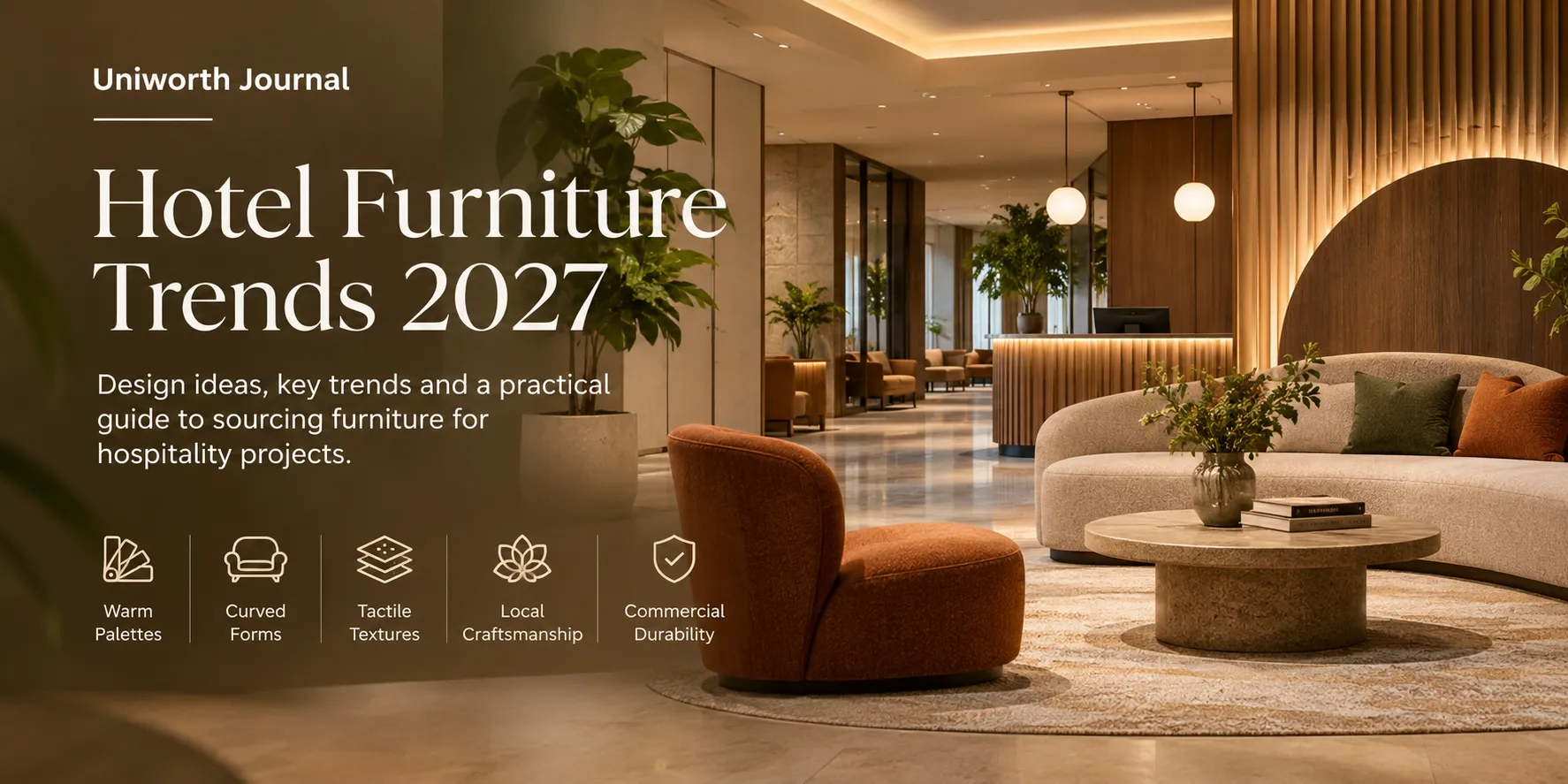
The cold greys and stark whites that dominated the last decade are giving way to warmer tones. Think walnut and teak wood finishes, sand and clay shades, terracotta accents, muted olive and deep forest greens. These colours make spaces feel calmer and more inviting, which is exactly what travellers want after a long journey.
Warm palettes are also forgiving. They hide everyday wear better than pure white or glossy black surfaces, and they pair easily with brass, cane, stone and greenery. For a property in eastern India, where humid weather and bright natural light are part of the setting, earthy tones feel natural rather than imported.
Trend 2: Curved and Organic Forms
Sharp corners are out; softness is in. Rounded headboards, arc-shaped lobby sofas, pebble coffee tables and barrel chairs are appearing across hotels of every size. Curves make a space feel relaxed, guide the eye smoothly around a room and reduce the harshness of rectilinear layouts.
There is a practical benefit too. In compact guest rooms, rounded corners on tables, desks and bedside units are safer and easier to move around. In lobbies, curved seating clusters encourage conversation and create natural zones without walls.
The catch is manufacturing. Curved forms demand precision in cutting, edge finishing and upholstery. A factory with computerised machinery and an experienced production team can deliver consistent curves across hundreds of identical pieces, which is essential when a hotel needs one design repeated across every room.
Trend 3: Texture and Tactile Comfort
Guests do not only see furniture; they touch it. That is why hospitality interiors are embracing layered texture: fluted or ribbed panels, woven cane inserts, soft bouclé-style upholstery, matte laminates and brushed metal details. Texture adds depth and luxury without shouting, and it lets a designer create richness even in a restrained colour scheme.
Fluted wooden panelling on a bed wall or reception counter has become especially popular because it photographs well and hides minor scuffs. Upholstered headboards in textured fabrics bring warmth and acoustic comfort. Matte finishes, meanwhile, show fewer fingerprints than gloss and feel more premium.
Trend 4: Visible Craftsmanship and Local Character
Guests increasingly want hotels that feel rooted in their location. Rather than generic international styling, many properties are choosing furniture that reflects regional craft: cane and wicker work, carved detailing, traditional motifs reinterpreted in clean modern shapes, and materials associated with local heritage.
For hotels in Kolkata, Howrah and the wider East India region, this is a real opportunity. A contemporary silhouette with a subtle craft detail tells a story that imported catalogue furniture cannot. It also gives interior designers a way to differentiate a project from competitors.
Visible craftsmanship extends beyond decoration. Clean edge banding, tight joints, even stitching and consistent finishing are all signs of quality that guests notice even if they cannot explain why the room feels premium.
Trend 5: Durability Built for Commercial Reality
Beautiful furniture fails the moment it cannot handle daily hotel life. Guest room furniture faces luggage impacts, spills, constant cleaning and heavy turnover. Lobby and restaurant furniture faces even more traffic. This is why commercial-grade construction is the quiet priority behind every successful hotel fit-out.
When reviewing furniture for a hotel, look closely at:
• Board quality and construction: strong, moisture-resistant boards and solid framing for beds, seating and casegoods.
• Surface finishes: laminates and coatings that resist scratches, stains and cleaning chemicals.
• Hardware: drawer runners, hinges and locks that survive thousands of cycles.
• Upholstery: fabrics and foam designed for constant seating, not household use.
• Edge detailing: sealed edges that keep moisture out.
A hotel that saves money on these points will usually spend more on repairs within a few years. Durable furniture is where good design and good business meet.
For Interior Designers: Sourcing Hotel Furniture in Bulk
If you are an interior designer, architect or project management consultant working on a hotel, resort, guest house or serviced apartment project, sourcing furniture in bulk brings its own challenges. Your design intent has to survive the journey from a drawing to hundreds of finished pieces, all consistent and delivered on schedule.
Here is what designers should look for in a manufacturing partner:
1. Ability to customise. Catalogue furniture rarely fits a specific concept. Look for a manufacturer whose design and production teams can work from your drawings, moodboards or a rough brief and develop them into buildable furniture.
2. Sample and mock-up approval. Insist on a prototype or sample piece before full production. This lets you check proportions, finish, colour and comfort with the client.
3. Consistency across quantities. The hundredth chair must match the first. Computerised machinery and documented quality checks make this possible.
4. Bulk capacity and timelines. Hotels open on fixed dates. Confirm that the factory can produce your full quantity and deliver in phases if the building is completed floor by floor.
5. Complete scope. A single partner that can supply guest room furniture, lobby seating, restaurant and banquet furniture reduces coordination effort and keeps the design language uniform.
6. After-sales support. Touch-ups, replacements and additional units will be needed later. A local manufacturer is far easier to reach than an overseas supplier.
Uniworth Furniture Manufacturing Company, based in Howrah, West Bengal, works with designers and hospitality developers to turn concepts into finished furniture. Our design team can prepare a hand-drawn structure from your requirements, and our production team customises it to specification. With 20+ years of experience, a large automated plant and ISO 9001:2008 certification, we are equipped to supply hotel projects in bulk.
Turning Trends into a Hotel Guests Remember
The hotel furniture trends of 2026 share one idea: guests want warmth, comfort and character, and owners want durability and value. Warm palettes, curved forms, tactile textures and local craftsmanship all help a hotel feel distinctive, provided the furniture is built to commercial standards.
Whether you are renovating an existing property or developing a new one, the right manufacturing partner makes the difference between a concept that looks good on paper and rooms that impress guests for years.
Planning a hotel or hospitality project? Share your brief with the Uniworth team through our Bulk Enquiry page, call +91 98309 08068 or email uniworthfurniture@gmail.com for a custom furniture proposal. Interior designers and architects are welcome to send drawings for a project-specific quote.